
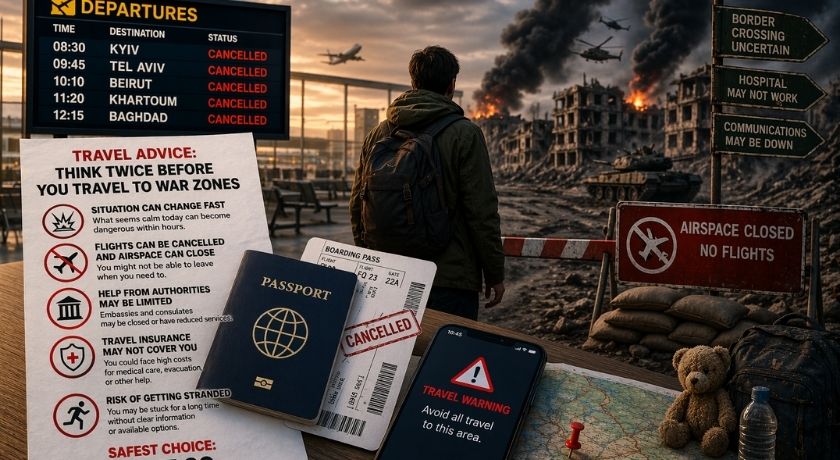
Traveling to countries or regions where there is war involves major risks, even when some parts of the country are temporarily described as relatively safe. The security situation in a war affected area can change very quickly. What seems calm in the morning may already be dangerous a few hours later. That is why people should avoid traveling to destinations where there is armed conflict.
War affects the whole society
A common misconception is that it is fine to travel to a country at war as long as you stay away from the front line. In reality, war affects the whole society. Infrastructure can be knocked out, communications can break down, and important public services may function poorly or not at all. Hospitals, transport, electricity supply, and mobile networks can all be affected, making even everyday situations difficult to handle.
It may become difficult to leave the country
Even if some zones in the country may be safe for the moment, travelers must be prepared for the possibility that the airspace can be closed at very short notice. Then regular flights may be canceled, and the chance to leave the country quickly can disappear. Travelers may be forced to look for other ways out, such as through land borders or ports, but those alternatives can also be unsafe, overcrowded, or completely unavailable. In an emergency, it may therefore become very difficult to get to safety.
Help from authorities may be limited
Another important aspect is that the ability of authorities to help is often limited in war zones. Embassies and consulates may operate at reduced capacity or close temporarily. The authorities of some countries also do not provide the same level of assistance if a person has knowingly traveled to an area that has been assessed as unsafe. This means that anyone who travels there may have to take greater personal responsibility for the consequences.
Insurance may not apply
Insurance may also stop being valid or provide very limited coverage when you travel to areas with an ongoing conflict. This can lead to major costs if you need medical care, evacuation, or other assistance. At the same time, the risk of becoming stranded for a longer period increases, without clear information about when it will be possible to continue traveling or return home.
The safest choice is not to go
For these reasons, the advice is clear: avoid traveling to destinations where there is war. Even when some parts of the country appear stable, there is always a risk that the situation will worsen quickly, that exit routes will close, and that help from authorities will be unavailable or severely limited. Choosing not to travel is therefore the safest and most responsible decision.