
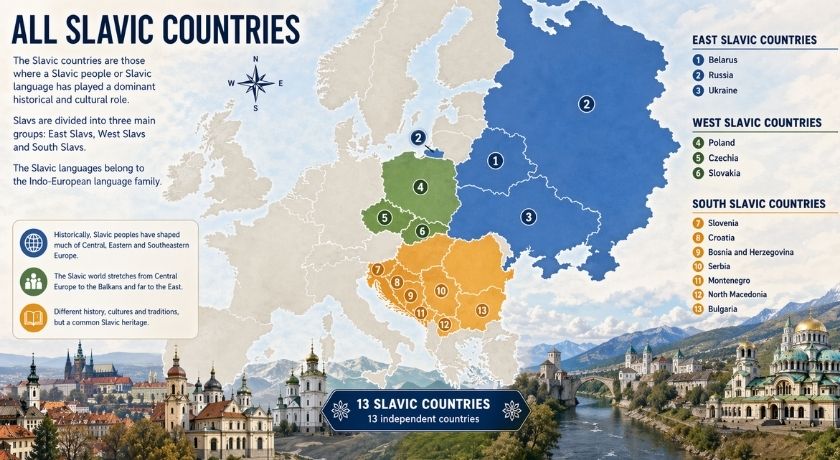
Slavic countries are not an official geopolitical group like the EU or the Nordic countries. Instead, the term is used for countries where a Slavic people or a Slavic language has played a dominant role. The Slavs are divided into three main groups: East Slavs, West Slavs, and South Slavs.
The Slavic languages belong to the Indo European language family. The linguistic division into East Slavic, West Slavic, and South Slavic languages is often used as a basis when discussing which countries are considered Slavic.
Historically, the Slavic peoples have shaped large parts of Central, Eastern, and Southeastern Europe. Therefore, the Slavic countries stretch from Central Europe to the Balkans and further east.
All slavic countries
East slavic countries
- Belarus
- Russia
- Ukraine
West slavic countries
- Poland
- Czechia
- Slovakia
South slavic countries
- Slovenia
- Croatia
- Bosnia and Herzegovina
- Serbia
- Montenegro
- North Macedonia
- Bulgaria
13 Slavic countries
If you count independent states, people usually speak of 13 Slavic countries.