
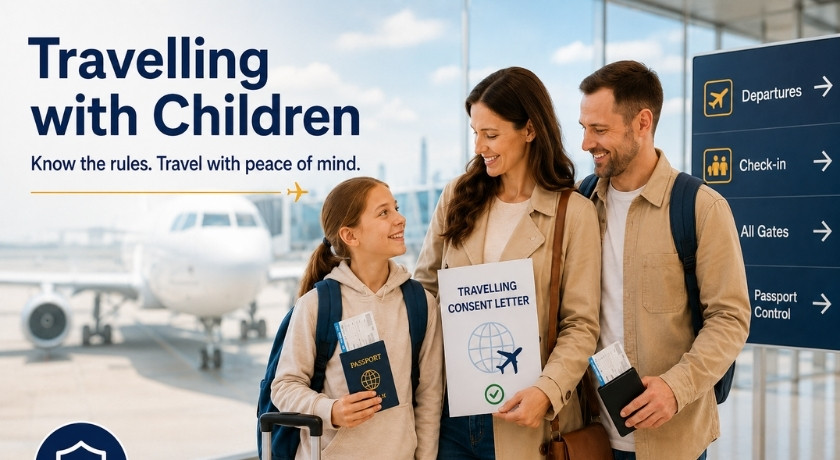
When a child is travelling internationally, travel documents and permissions must be ready before the journey begins. This applies whether the child is travelling with both parents, with one parent, with another adult or alone.
Rules may differ between countries, airlines and border authorities. You should therefore always check the requirements for the departure country, transit countries and destination country before every trip.
Children must have valid travel documents
A child must have the correct travel documents for the trip. For international travel, this usually means a passport. In some cases, a visa, residence permit, birth certificate, custody decision or other supporting documents may also be required.
The travel documents must be valid for the entire journey and meet the requirements of the country the child is travelling to. Some countries also require the passport to be valid for a certain period after entry or after the return journey. Airlines may refuse boarding if the documents do not meet the requirements, even if the ticket has already been paid for.
When a consent letter for travel should be brought on the trip
When a child travels without both legal guardians, a written travel consent should usually be brought. This applies especially when the child travels:
- With only one parent
- With a relative
- With a coach, teacher or group leader
- With a family friend or another adult
- Alone
A travel consent shows that the child’s legal guardians have approved the trip. Many authorities state that children travelling alone or with only one parent or legal guardian need a consent letter.
The consent should be written, signed and clear
Verbal approval is not always enough at border control or check in. The consent should therefore be written and signed by the legal guardian or legal guardians who are not travelling with the child.
Border control may require proof of permission
Border authorities may check that a child has the right to travel with the adult accompanying the child. They may ask questions about the relationship to the child, the purpose of the trip, who has approved the journey and how the legal guardians can be contacted.
If documents are missing, the journey may be delayed or stopped.
Sole custody often requires extra proof
If one parent has sole custody, this must be shown with an official document. If a legal guardian has died, a death certificate may be needed. If a court has decided on custody, travel or visitation, the decision should be brought along.
This is important because border authorities and airlines may need to see why only one person has the right to approve the child’s journey.
A consent letter for minors is a safety measure
The purpose of travel consent is to protect the child. The document reduces the risk of misunderstandings, custody disputes, unauthorised travel and suspicion of abduction.
A clear travel consent also makes it easier for responsible adults to show that the trip has been approved. It creates security for the child, legal guardians, airlines and authorities.