
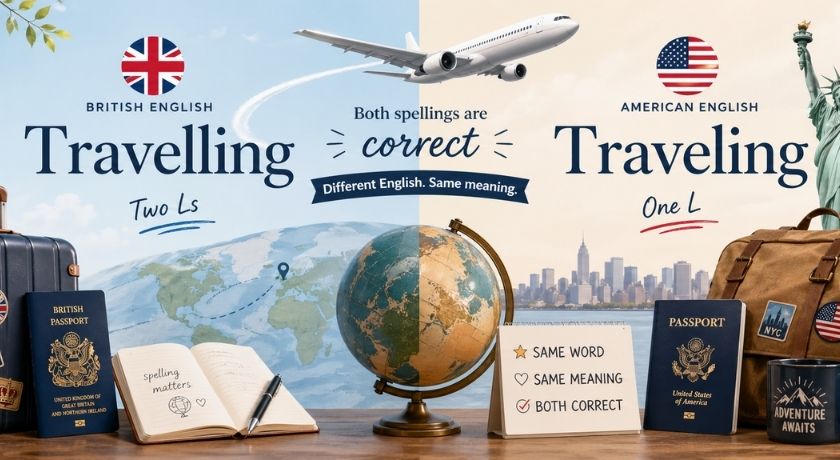
The short answer is that both spellings are correct. The difference is not about right or wrong, but about which variety of English you use.
In British English, people usually write:
travelling
In American English, people usually write:
traveling
Why are there two spellings?
This means that the spelling depends on your target audience, the context and the language standard you want to follow.
The word comes from the verb travel, which means to go from one place to another. When the ending ing is added, the question is whether the letter l should be doubled or not.
In British English, it is common to double the l in words like these:
travel becomes travelling
cancel becomes cancelling
label becomes labelling
In American English, the spelling is often simplified and only one l is used:
travel becomes traveling
cancel becomes canceling
label becomes labeling
The same difference also appears in the past tense:
British English: travelled
American English: traveled
Which spelling should you choose?
It depends on who you are writing for.
If you are writing for a British, European or international audience, travelling is often a safe choice. It is the spelling used in British English and feels natural in many international contexts.
If, however, you are writing for an American audience, you should use traveling. It is the standard spelling in American English and looks most natural to readers in the United States.
The most important thing is to be consistent. Do not mix British and American spelling in the same text. Choose one variant and stick to it.
Examples in sentences
British English:
I love travelling during the summer.
American English:
I love traveling during the summer.
Both sentences mean exactly the same thing:
I love travelling during the summer.